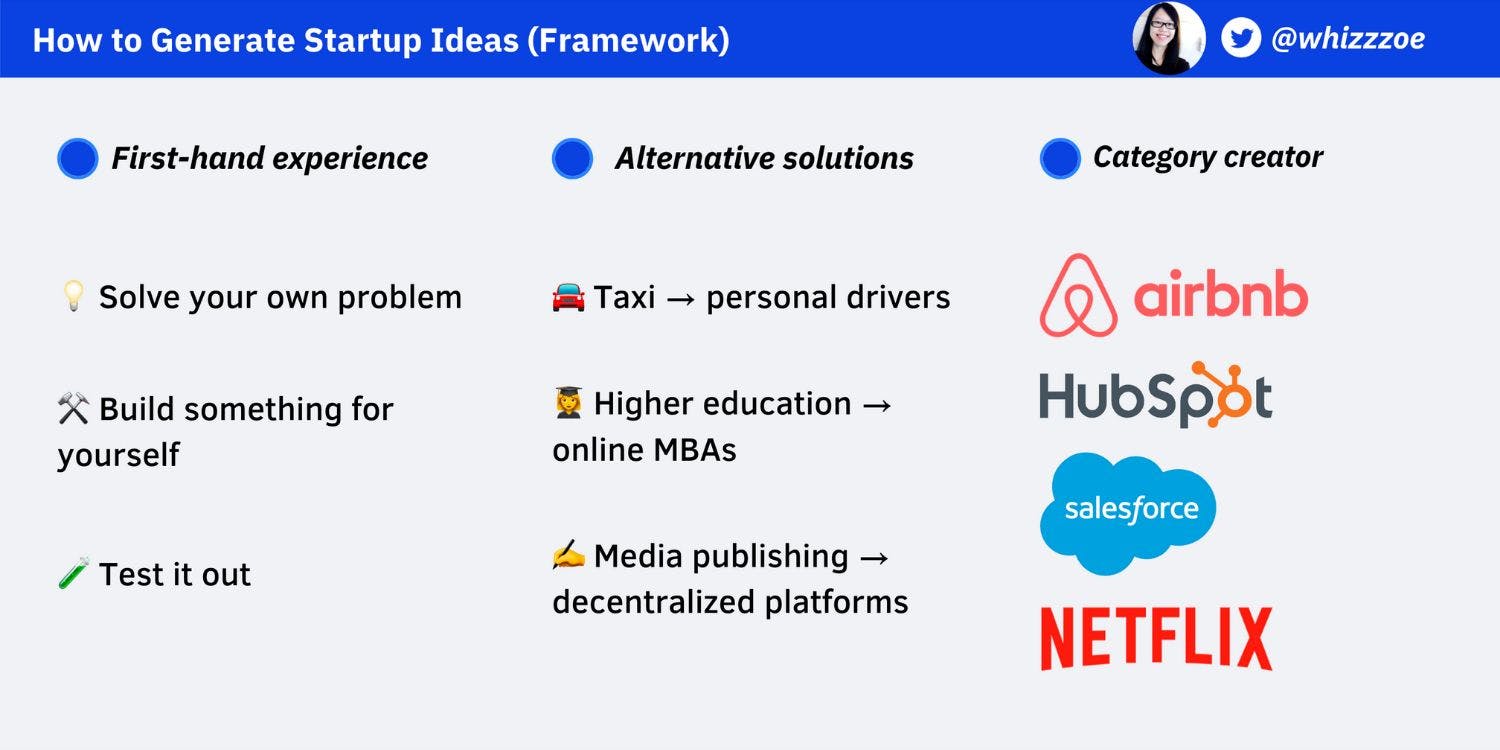
This article is part of my ↗️ where I share insights on building things in tech. Join me :) Note: resource newsletters 👋 I’m , a product builder. I’ve built multiple apps using the method: , , , , , , +more Zoe Chew rapid MVP sneaker app personal FAQ meal kit app virtual event app SaaS tracker food delivery content app If you’ve read my this is a follow-up series. I provide three frameworks to discover great startup ideas (so that you will never run out of product ideas). Whether you’re finding MVP ideas or going through the idea maze for your next big things, this post will help build your idea muscles. Product/Market fit article , 1. Solve your own problem One of the most straightforward ways to find ideas for your startup is to solve problems facing you in day-to-day life, workplace, or communities you care about. Ideas backed by problems you have first-hand experience with are a great way to start. Once you have identified what those problems are, figure out what solutions work best, build something for yourself, find people who have the same problems, and get them to use it. For example, Dropbox Image: Dropbox in its early days Drew Houston mentioned how he discovered the idea for Dropbox in this : podcast interview “It was really out of personal frustration…I kept carrying a thumb drive around and emailing myself files and all the things. I was going from Boston to New York on the Chinatown bus, forgot my thumb drive, and I was so frustrated. And I’m like, my God, I never want to have this problem again.” He started writing code to solve the problem. He then realized synching files over the Internet could become a service that helps people access online documents anytime, anywhere. 2. Create alternative solutions This framework requires you to think in terms of the existing solutions. Evaluate the disadvantages, the cons, why they suck and then generate alternative solutions as your startup idea. Typically, it lies within these factors: cost, speed, friction, gatekeeping, status quo, and restriction. For example: (1) The alternative of taxi → personal drivers Instead of wasting time standing in line, you can book a driver from your smartphone and a car will arrive within 3 minutes. It’s fast, convenient, and hassle-free. For example, Uber and Lyft. Image: Uber (2) The alternative of higher education → online MBA Traditionally, an MBA costs around $55,727 to $161,810. People enroll in an MBA for credentialling or getting high-paying jobs. The alternative can be expert communities that help you succeed in your career. It’s high-signal, peer-to-peer-based learning, 80% cheaper, and faster completion in weeks not years. For example, and . On Deck altMBA Image: On Deck (3) The alternative of media publishing → independent or decentralized platforms In the past, to get a book published, you need to go through book publishers; or a movie distributor for film publishing. democratizes access for authors. decentralized access for movie creators and give them direct access to an audience, data, payment, and investors through blockchain. Amazon Self-Publishing MovieBloc Image: MovieBloc 3. Category creator This approach is known as “category design”, a term coined by the authors of The idea is to create an entirely new market, new business category, new product, or service. “Play Bigger.” In other words, you innovate beyond existing competitors by designing your own space. If you look into the past 25 years, newer companies that beat incumbents are rather than becoming . For example, category creators better competitors (1) Airbnb — vacation rental marketplace By moving away from the existing hospitality industry, Airbnb unlocks inventories (e.g. housing, events, trips, experiences) through sharing economy and platformization. Image: Airbnb (2) Netflix — online movie streaming For decades, brick-and-mortar video rental stores dominated the household entertainment market. Netflix created an online streaming platform and provides movie content available at your fingertips. Image: Netflix (3) HubSpot — inbound marketing Hubspot coined the term “inbound marketing” and creates solutions that focus on attracting buyers through automation (e.g. content, drip emails, lead generation, workflow integration) rather than relying on manual outreach, hard-selling, and closing prospects. Image: HubSpot (4) Salesforce — cloud-based software In the early days, the enterprise software market was dominated by software licensing and required hardcopy installation. Salesforce enables enterprise software in the cloud. It’s cheaper — pay monthly instead of one lump sum. It’s convenient — just connect to the Internet. Image: Salesforce 🎁 Bonus tips: Habits that strengthen your idea generation muscle Use a Kanban board to keep track of problems, solutions, ideas, and execution status. Be intellectually curious. Always ask yourself: What could be done differently in your industry? What are the new ways of doing things? Participate in the founders’ community. Schedule 1:1 calls for brainstorming. Analyze market opportunities and where your solutions can fit and monetize. discover unmet needs Prototype your ideas and create apps to solve your own problems.Participate in online hackathons — you can build with code or without code. Join online forums, groups, and rooms. Take notes on people’s frustrations and convert them into potential solutions. Build things, launch things, see if people are using them. Improve your solutions, therefore, improve your intuition for good ideas. More Startup Opportunities: 🛍 Online Shopping: Opportunities and Monetization 🧠 D2C Wellness: Monetization & Opportunities 🏡 Future of Real Estate Tech 🤑 Future of Digital Monetization 🧑🏫 Future of Education 🕹 Creator economy of Gaming 💻 Unbundling of Excel and the Future of SaaS 🛒 E-commerce roll-ups ✈️ Web 3.0 for creators, Travel apps & Low-code tools 📲 Marketplaces, on-demand economy & employee motivation 🏥 Alternative Assets, Online Healthcare & Family Offices 🏋️♂️ Curation economy, Social communities & Online Learning [1] Find me on Personal Site / Twitter / LinkedIn 🔥 [2] Next tech insight in your inbox — Join my newsletter 💌 Also Published Here